MVP Product Design
COLOUR
From a founder's vision to a fundable MVP — leading product strategy and identity-driven design for a cross-continental pre-seed startup team.
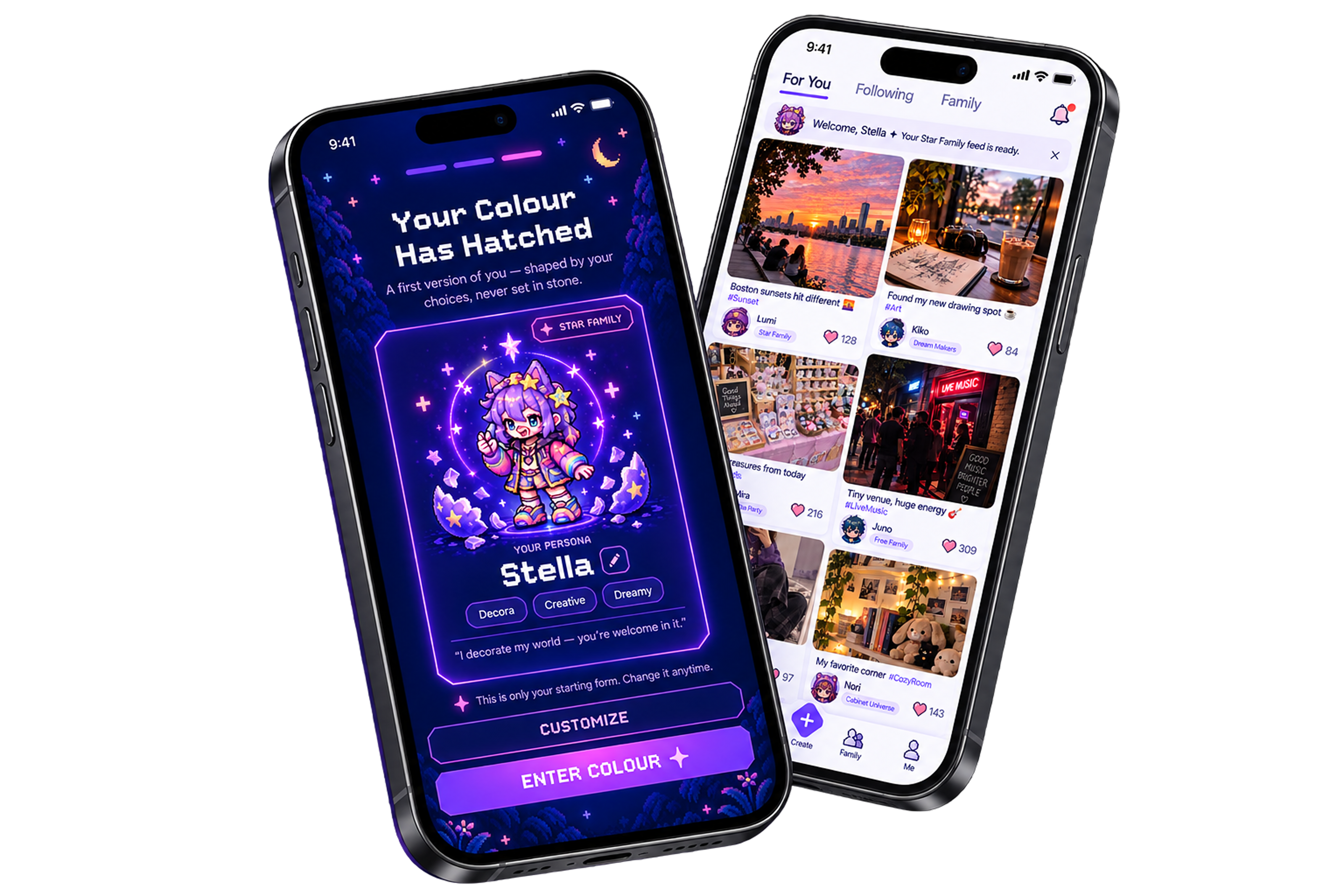
From a founder's vision to a fundable MVP — leading product strategy and identity-driven design for a cross-continental pre-seed startup team.
Project Context
The team had a business opportunity and an initial PRD for pre-seed fundraising. What was missing was the product design layer: user validation, clear MVP scope, information architecture, and a prototype the team could test and pitch.
My role was to turn a broad founder-led idea into a focused, research-informed MVP within 6 weeks.
COLOUR is an identity-driven social platform for discovering niche communities through digital family identities, AI-generated personas, and shared cultural interests.
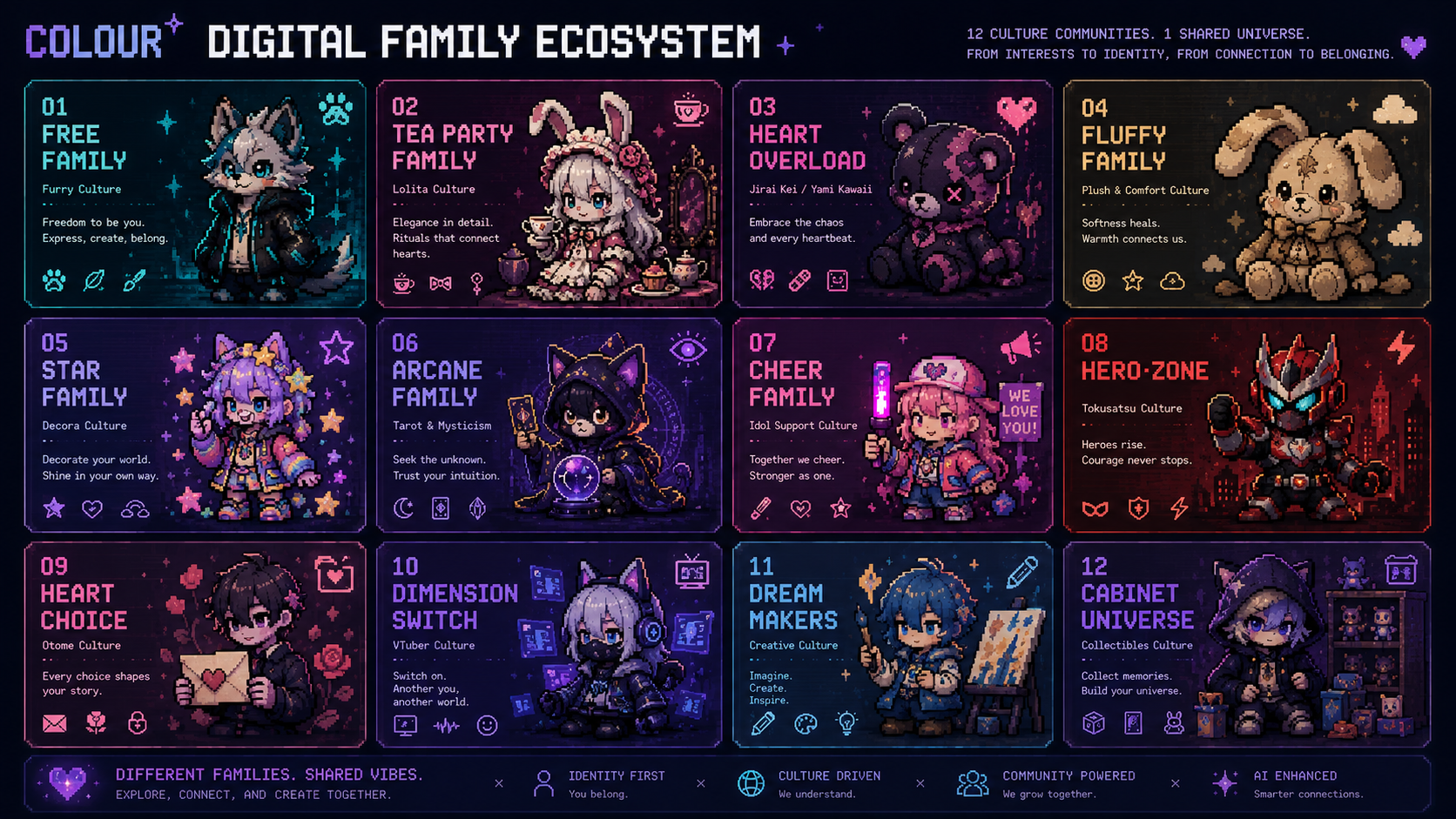
The core idea: replace shallow interest tags with 12 Digital Families and an onboarding ritual called the Unknown Egg.
Team · Cross-functional 15+
Duration
6 Weeks
May – Jun 2026
Stage
Pre-Seed MVP
Fundraising
Sprint Timeline
Research & Competitive Analysis
30 surveys, 5 user interviews, competitive landscape mapping across Instagram, TikTok, Discord, Reddit
Product Strategy & MVP Definition
COLOUR Framework, Digital Family concept, Taste Graph architecture, MVP scope with founders
UX Design & AI-Assisted Exploration
IA and layout drafts (GPT + Stitch), visual concept exploration (即梦), persona generation (GPT + image AI), hi-fi screens
MVP Usability Testing & Iteration
5-user usability test, funnel review, P0/P1/P2 backlog prioritization
Developer Handoff & Investor Demo
Figma component documentation, handoff specs, investor demo prep for pre-seed fundraising
My Responsibilities
This project was not just UI production. My value was turning an unclear product idea into a testable MVP with research, structure, and execution.
Product Strategy
User Research
UX Design
Cross-functional Collaboration
01 — Align the Business Vision
When I joined, the team already had an initial PRD. My first responsibility was aligning business goals, user needs, and technical feasibility before any interface design began.
Business Goal
Validate whether an identity-first, family-based community model creates more belonging than interest-tag feeds — and prove it's fundable.
User Problem
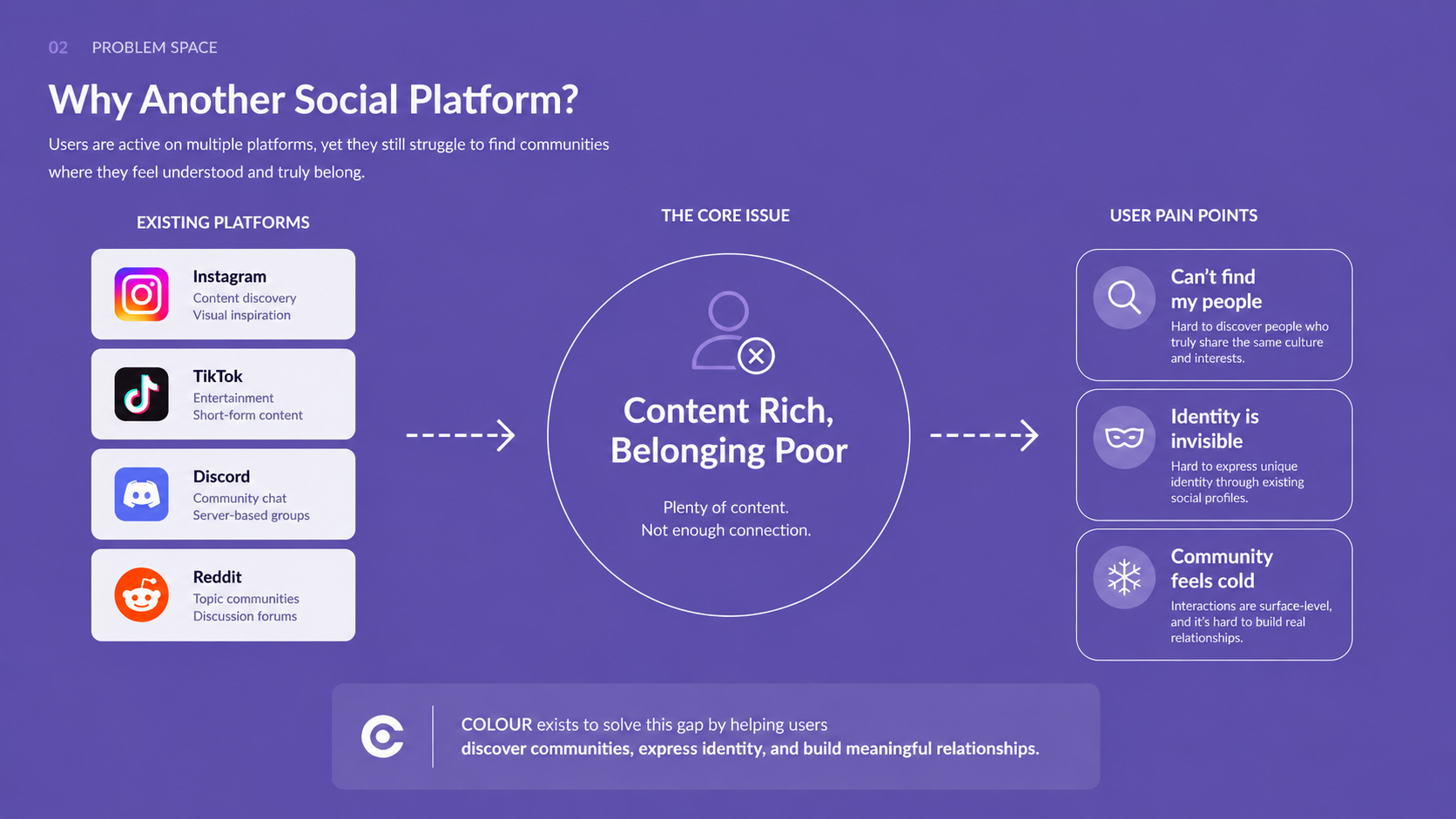
Niche culture communities are content-rich but belonging-poor on platforms like Instagram, TikTok, Discord, and Reddit.
Success Metrics
Profile completion, persona creation, recommendation clicks, squad entry, and first-post conversion.
Stakeholders
UK-based founders, a 5-person engineering team, business & growth, and a design team split across China, UK, and US.
Technical Constraints
Reuse mature mobile conventions for common interactions, then add a thin branded layer for COLOUR's custom identity moments.
02 — Validate Assumptions
Before designing screens, I needed to test whether users actually wanted identity-first belonging, not just another content feed.
Problem: users can consume endless niche content on Instagram, TikTok, Discord, and Reddit, but still struggle to find people who share the same cultural wavelength.
Design opportunity: make identity the entry point. Instead of asking users to follow tags, help them discover who they are, where they belong, and what community to enter next.
User Research
I used surveys, interviews, competitive analysis, and affinity mapping to turn founder assumptions into design criteria for onboarding, identity creation, and community discovery.
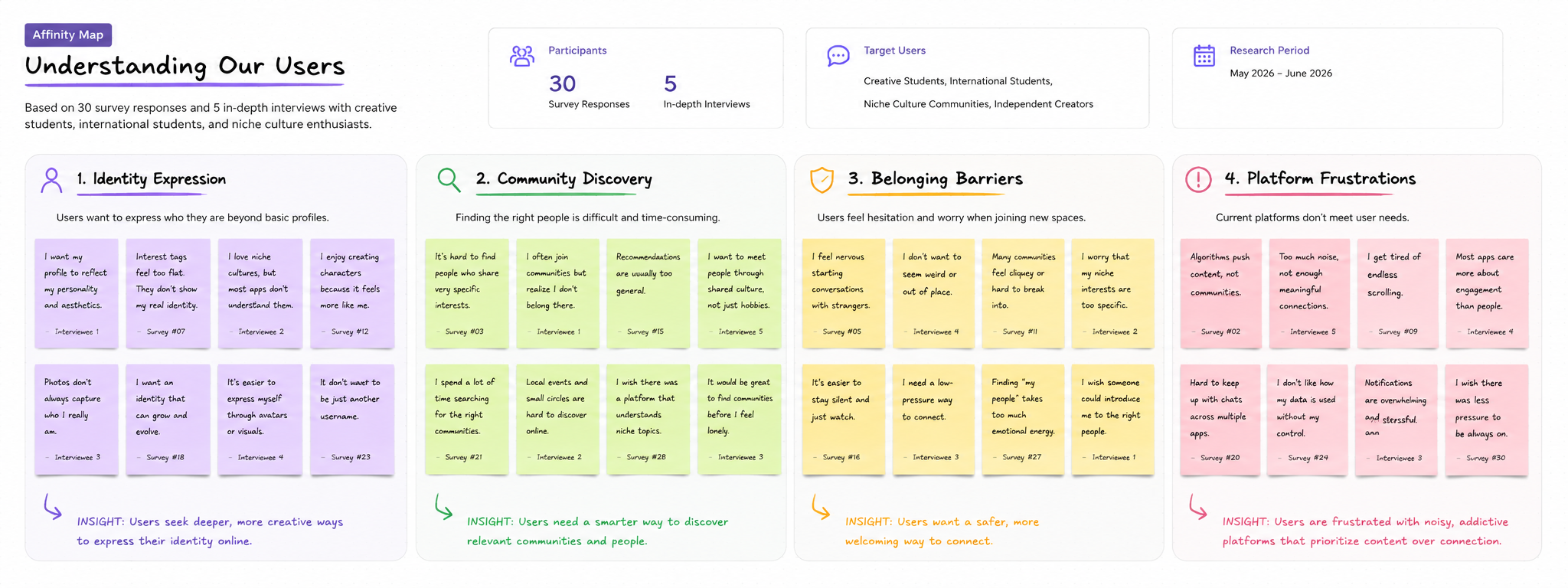
Affinity Map — synthesised from 30 surveys and 5 user interviews
AI accelerated transcription and affinity clustering, allowing the team to focus on interpreting insights rather than manually organising notes.
Research Findings
Insight 01
People want to find their people.
Users don't just want content — they want to feel seen by others who share the same cultural wavelength.
Insight 02
Identity matters more than content.
The desire to express who you are — aesthetically, culturally, creatively — drives community attachment more than content quality.
Insight 03
Users want low-pressure social interactions.
The anxiety of cold social spaces is a major barrier. Users need gentler, more contextual entry points into community.
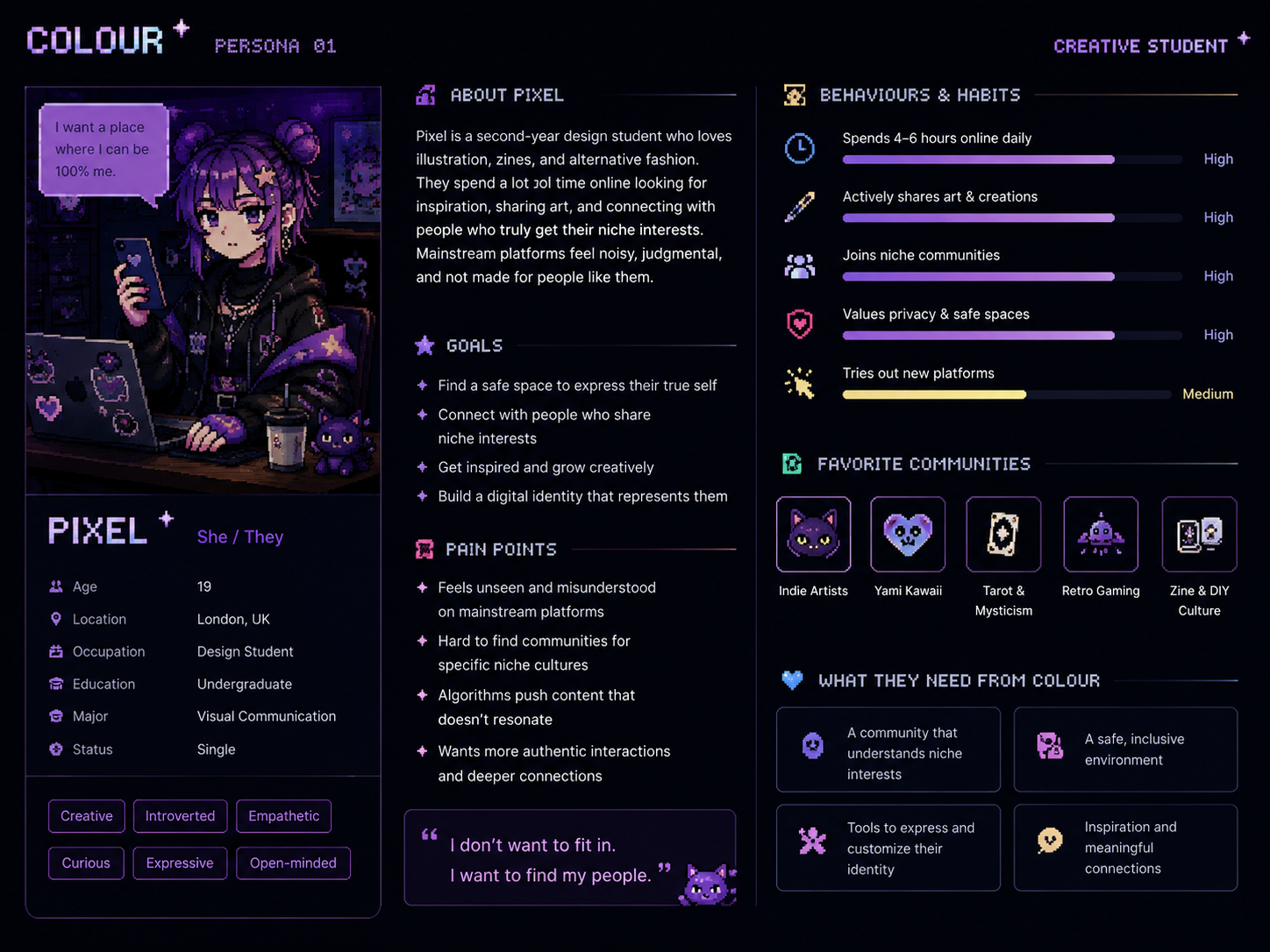
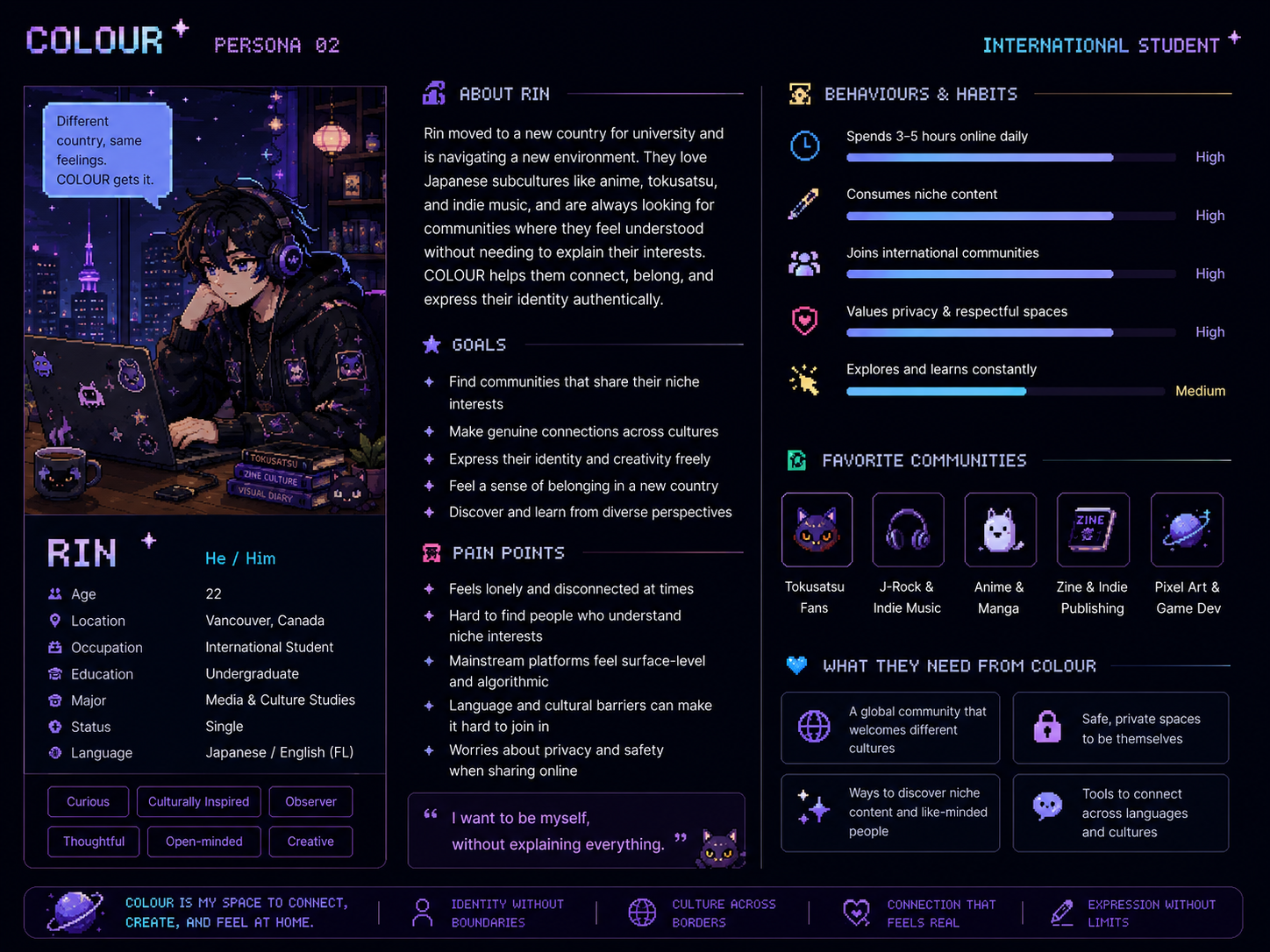
User Personas
Based on research synthesis, we identified two primary user archetypes that represent the core needs of COLOUR's target audience — niche culture enthusiasts who are underserved by mainstream social platforms.
User Journey Map
The journey map traces the emotional arc of a new user across six stages — from discovering COLOUR to becoming an active community member. It surfaces pain points at each touchpoint and identifies key design opportunities that directly shaped our product decisions.
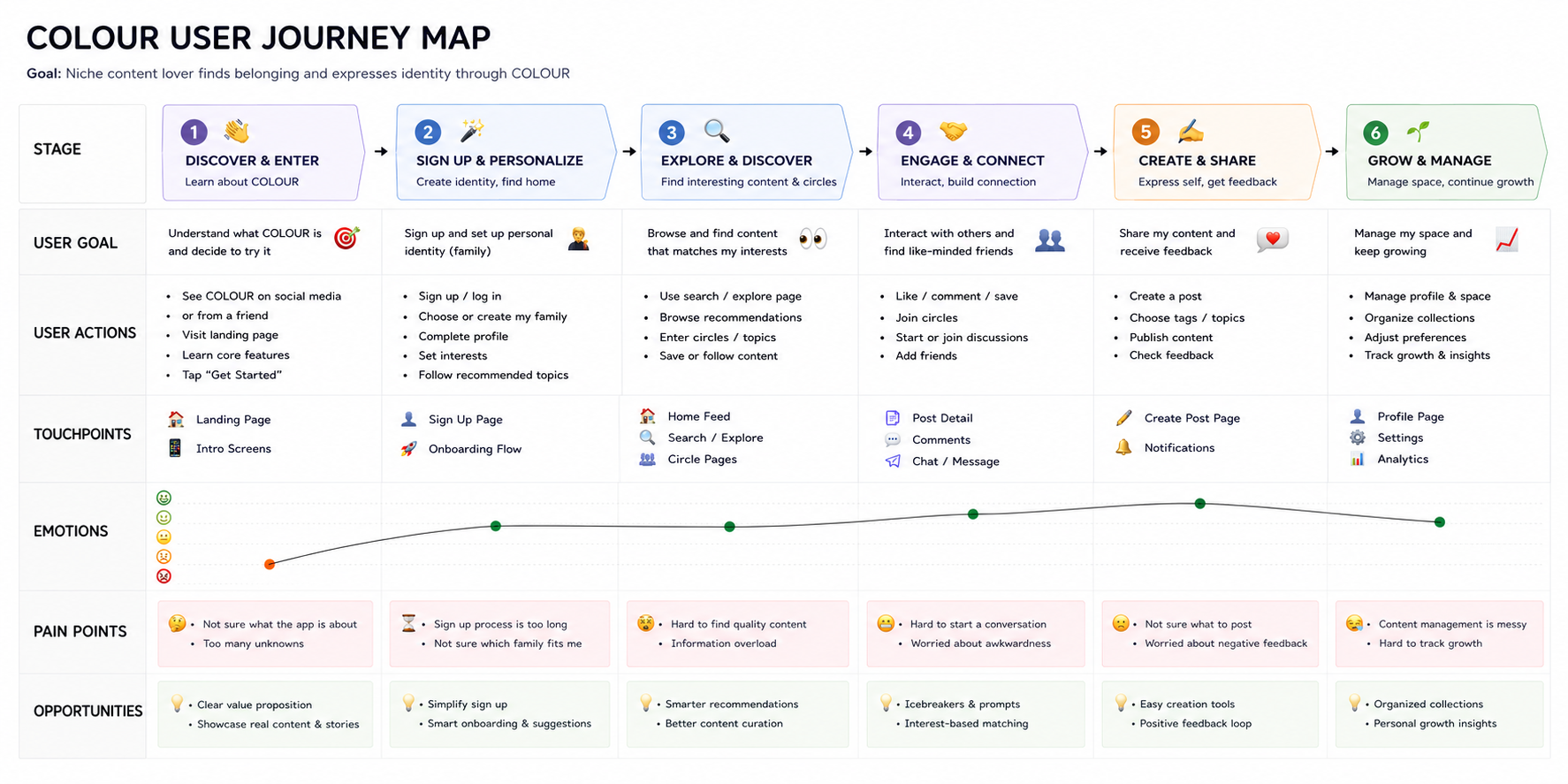
User Journey Map — 6 stages from discovery to long-term engagement
03 — Define Product Strategy
This section answers the key product question: what should the team build first, and why?
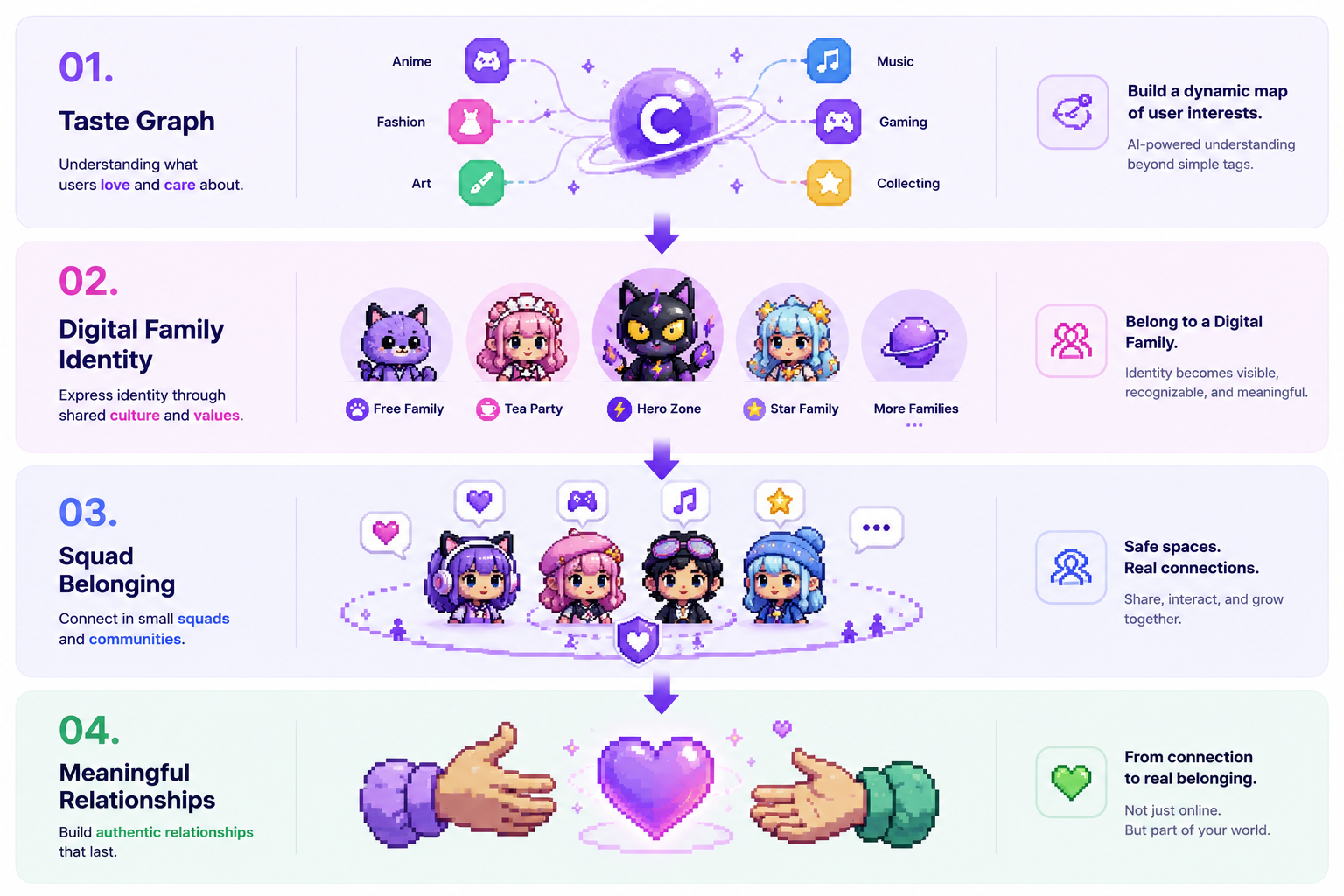
The COLOUR Framework
The core solution was a Taste Graph: a lightweight identity layer that connects cultural preferences, aesthetic signals, and community behaviour.
It gave the MVP a clear loop: Digital Family Identity → Squad Belonging → Meaningful Relationships.
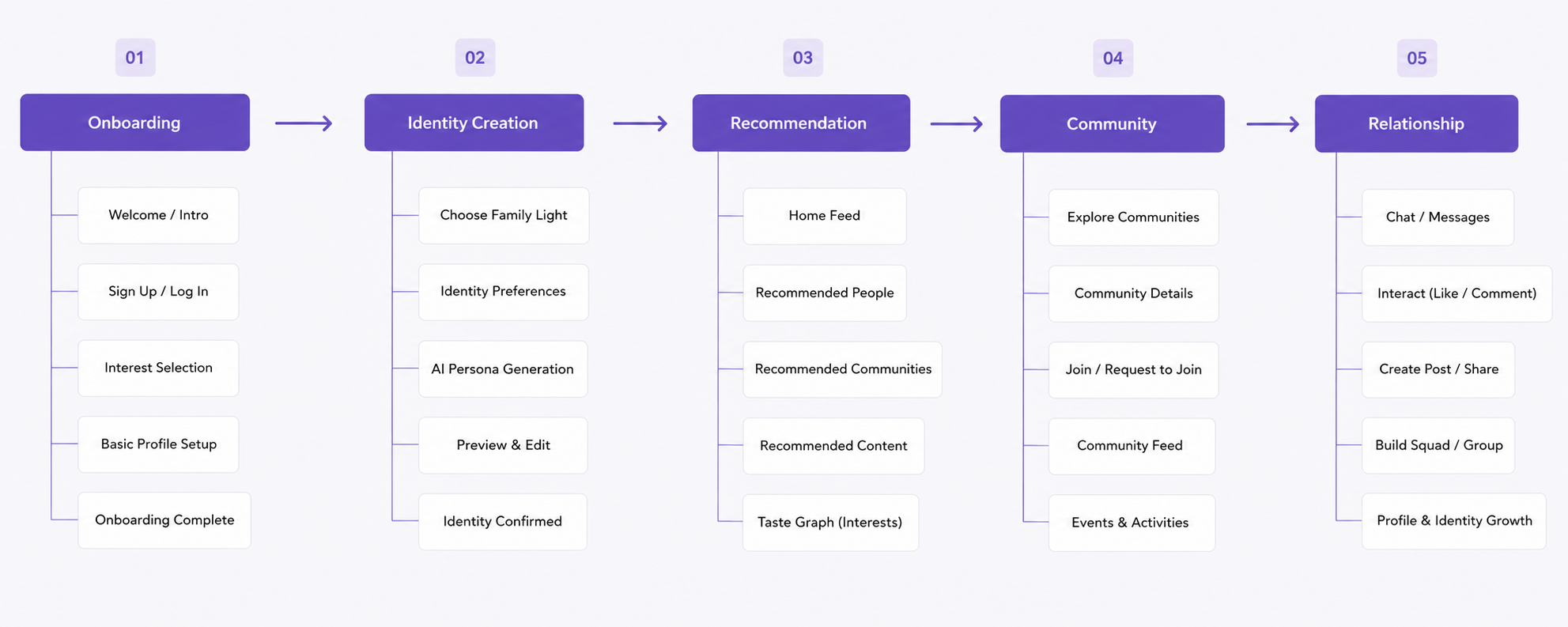
Onboarding → Identity Creation → Recommendation → Community → Relationship
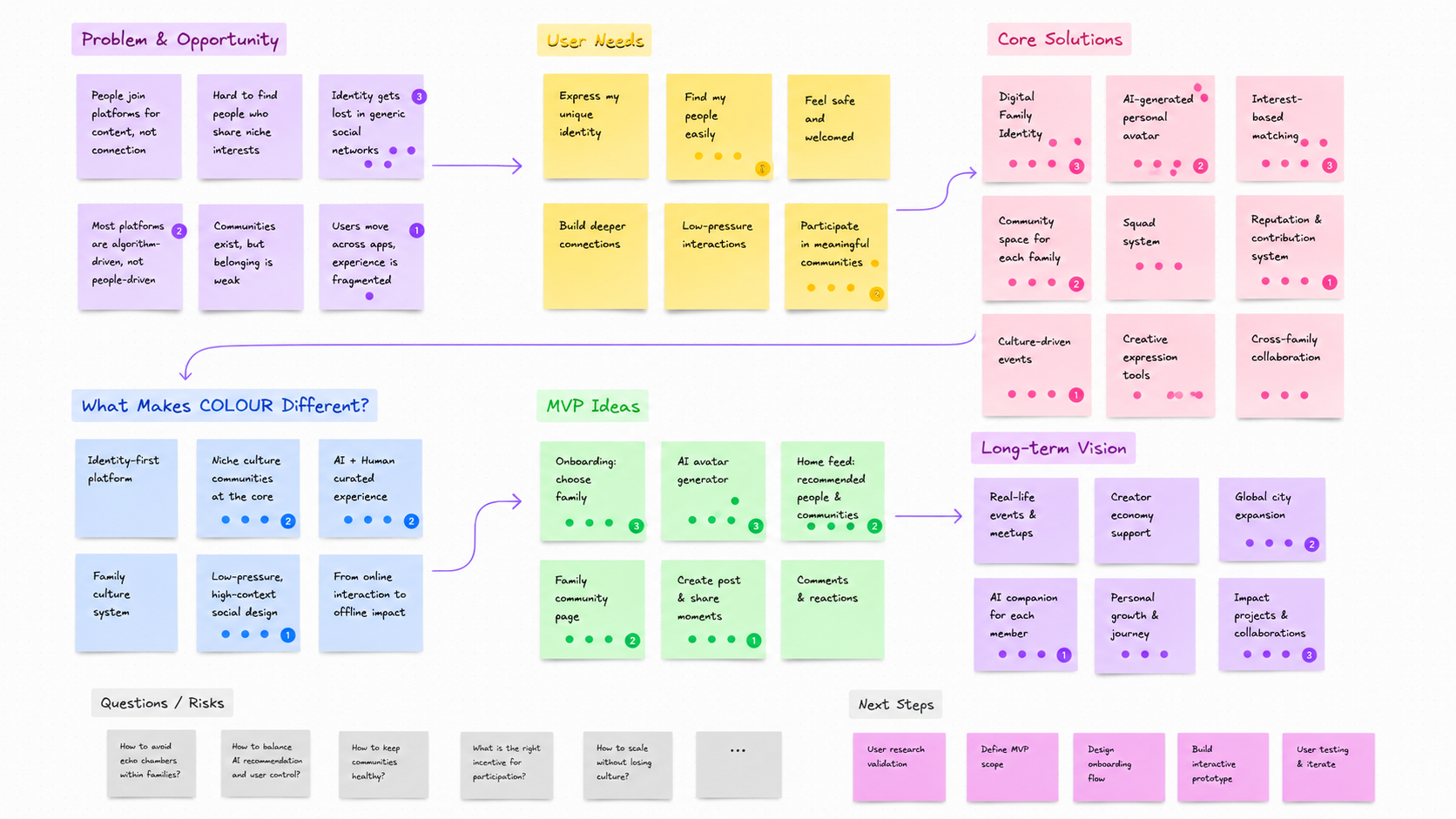
SWOT
I used SWOT to pressure-test the idea against real constraints: pre-seed funding, a distributed part-time team, engineering capacity, and the need for an investor demo in 6 weeks.
Strengths
Weaknesses
Opportunities
Threats
Decision: given the part-time, cross-time-zone team and lack of validated data, we prioritised the fastest path to a testable core loop — English-first, UK-first — over building every feature founders had originally envisioned.
Prioritization Matrix
The MVP was scoped by matching each research insight with feasibility, not by trying to ship every feature in the PRD.
High Priority · High Feasibility
High Priority · Medium Feasibility
Medium Priority · Lower Feasibility
Low Priority · Low Feasibility (for MVP)
MVP Scope
Build Now
Future Roadmap
04 — Interaction & Visual Design
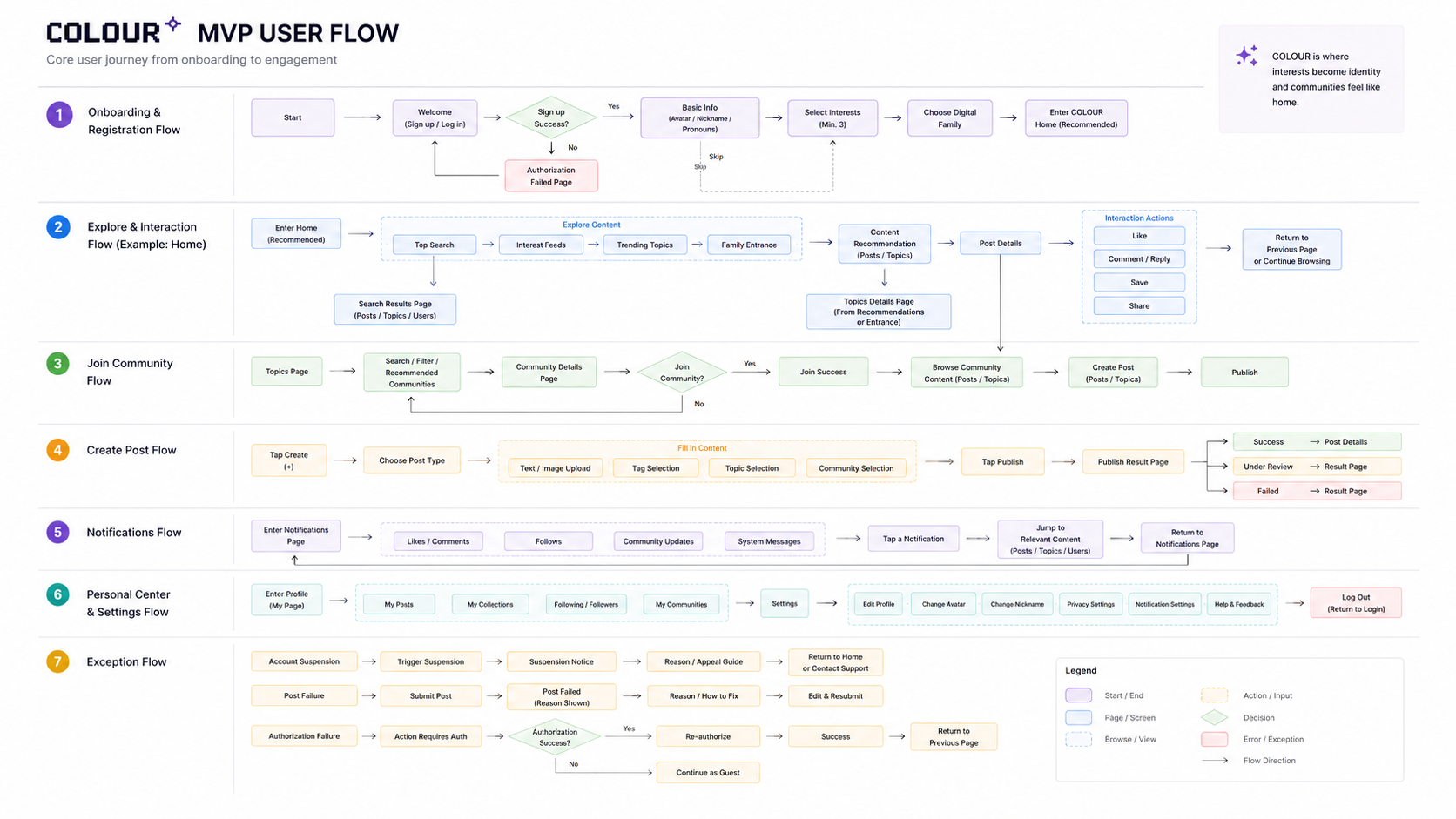
I mapped seven core flows before high-fidelity design so the team could align on logic, edge cases, and feasibility before committing to visuals.
12 Digital Families
The core of COLOUR's differentiation is the Digital Family system — 12 distinct cultural worlds, each with its own visual language, identity artefacts, and community culture. Users belong to a Family, not just a category.
The Unknown Egg
Onboarding is designed as an identity ritual, not a registration flow. Users begin as an Unknown Egg — undefined, full of potential. Through a series of choices, the egg absorbs Family Light and transforms. AI then generates a unique Digital Persona based on the user's selections.
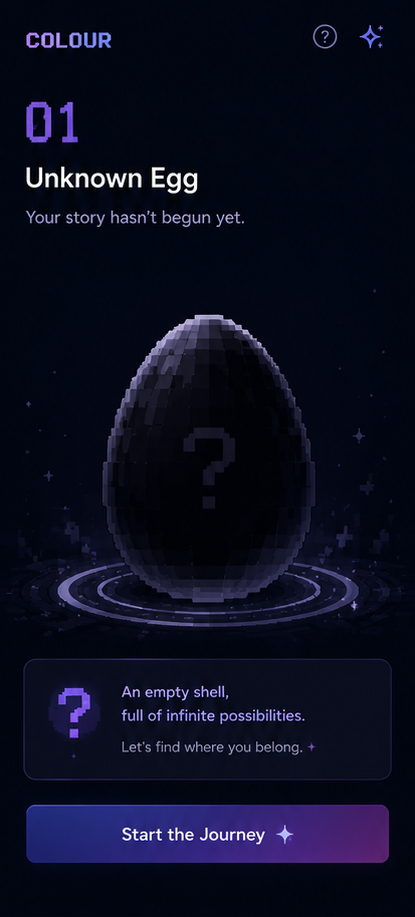
Unknown Egg
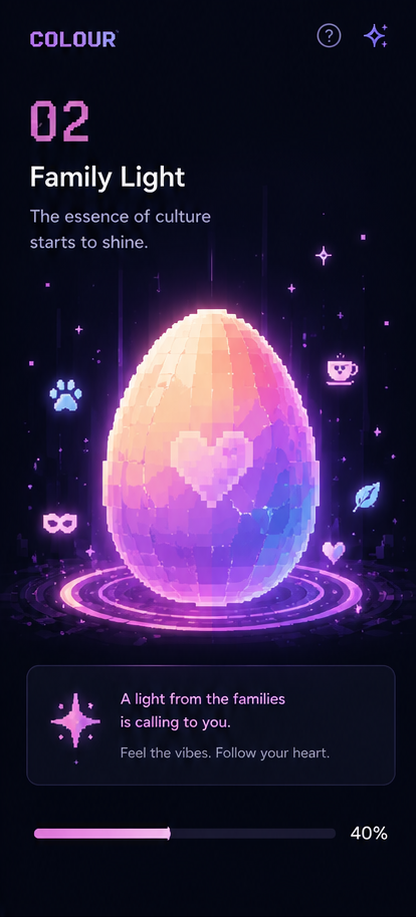
Family Light
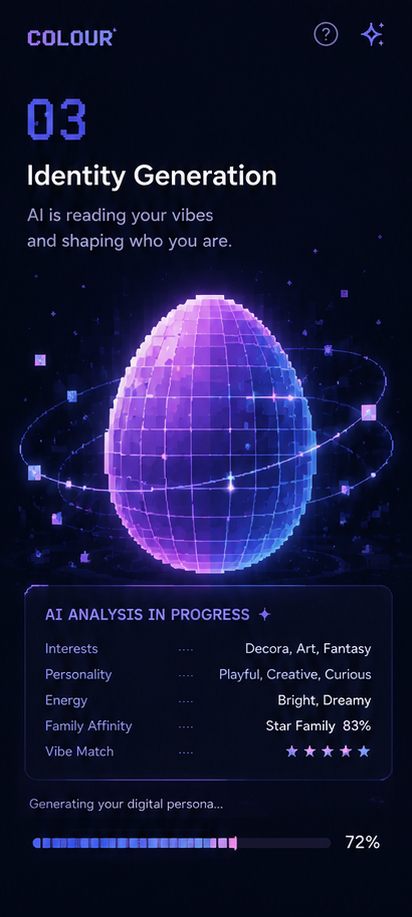
Generation
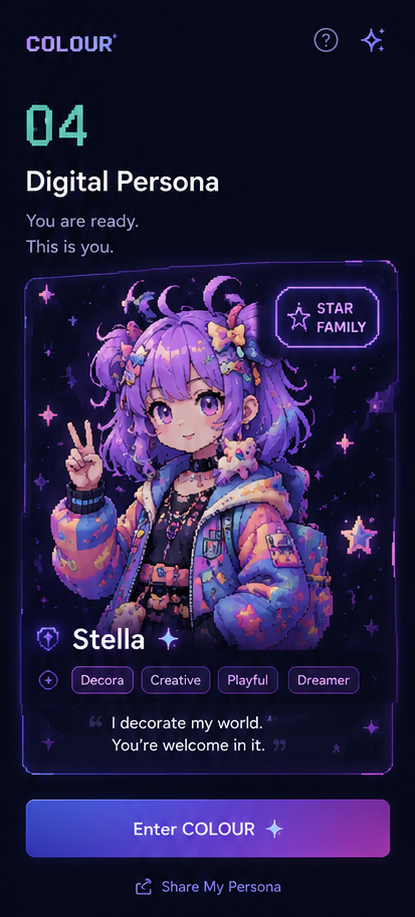
Digital Persona
I used AI-assisted tools to accelerate visual exploration and organize initial token directions, then refined hierarchy, readability, and component rules based on MVP scope and engineering feasibility.
MVP-Ready Design Foundation
Because COLOUR was an early-stage MVP, I avoided building a heavy enterprise-level design system. Instead, I created a lightweight foundation covering color, typography, 8pt spacing, buttons, cards, navigation, and reusable content patterns.
The approach was simple: reuse familiar mobile conventions for common interactions, and customize only the product-defining moments — Unknown Egg, Digital Families, Persona Cards, pixel icons, and avatar visuals.
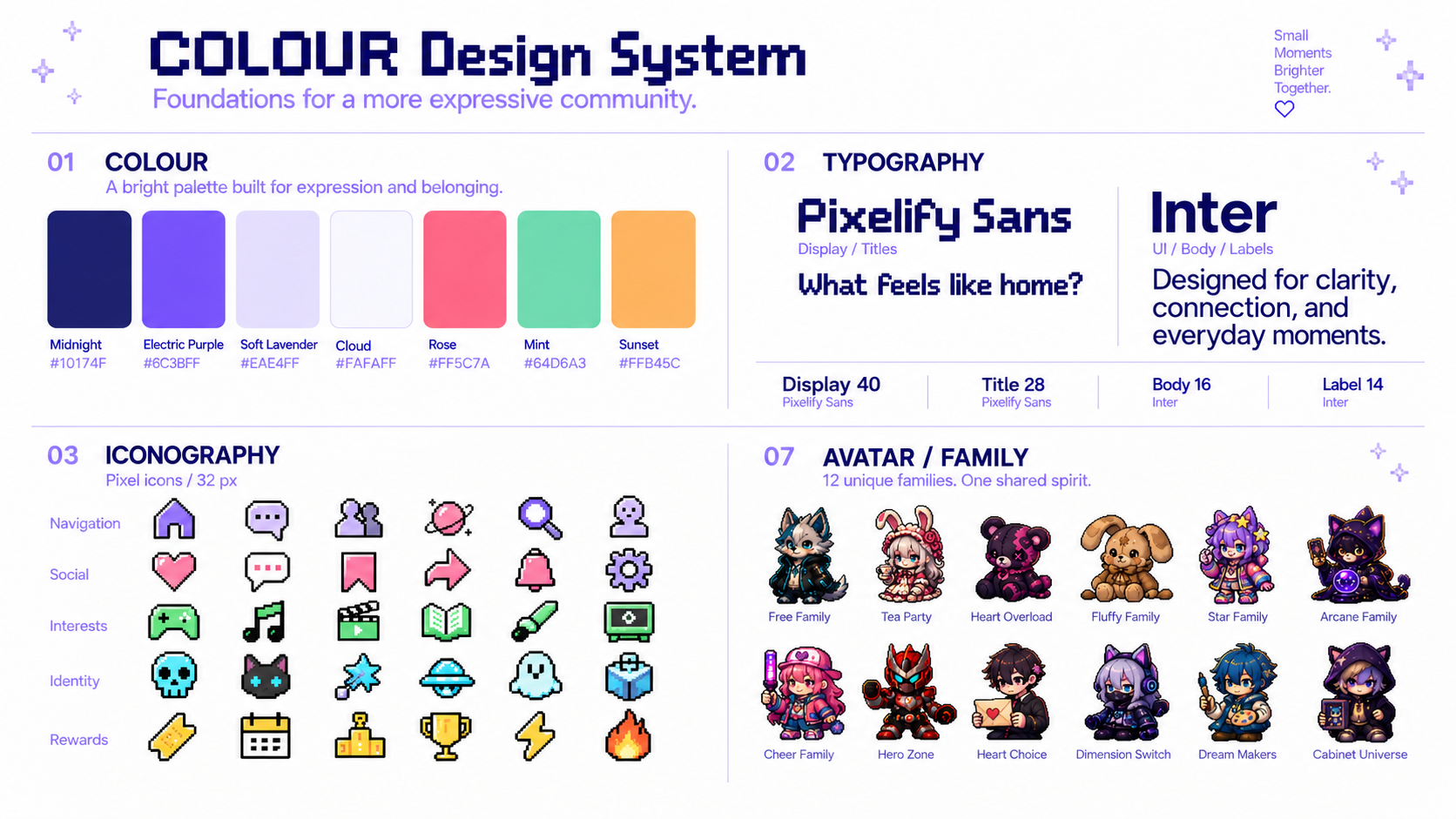
Onboarding Experience
The onboarding flow turns registration into an identity ritual: users choose interests, explore families, and create a persona before entering the community.

Welcome

Sign Up / Log In

Choose Interests

Choose Family

All Families

Create Avatar
Swipe or use arrows
Home & Community
The home feed is powered by the Taste Graph — surfacing content by cultural alignment, not just engagement metrics.

Home Feed

Search / Discover

Circle Detail
Swipe or use arrows
Create & Profile
Content creation is a relationship trigger — posts, events, and interactions are structured to facilitate real connections within Families and Squads.

Create Post

Profile

Post Detail
Messages & Notifications

Notifications
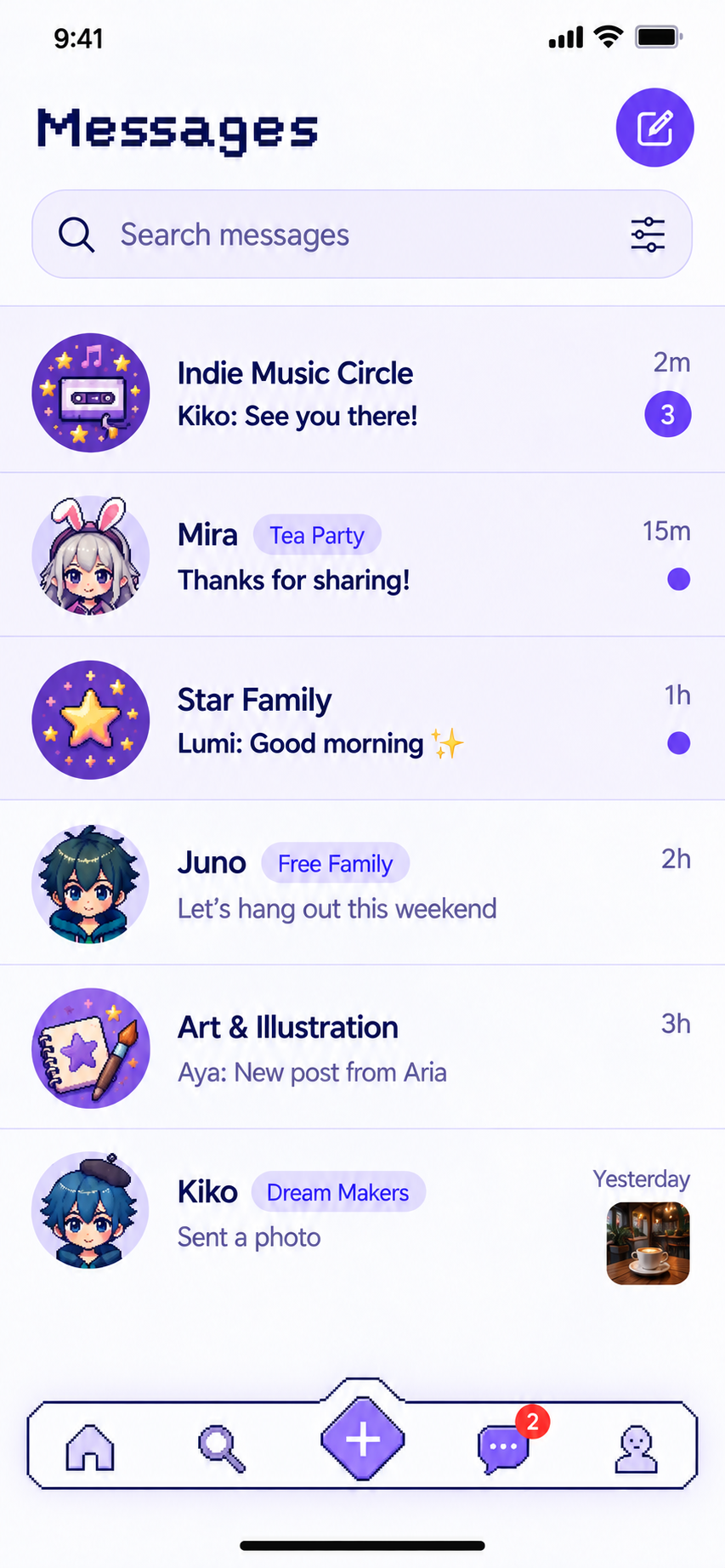
Chat / Messages
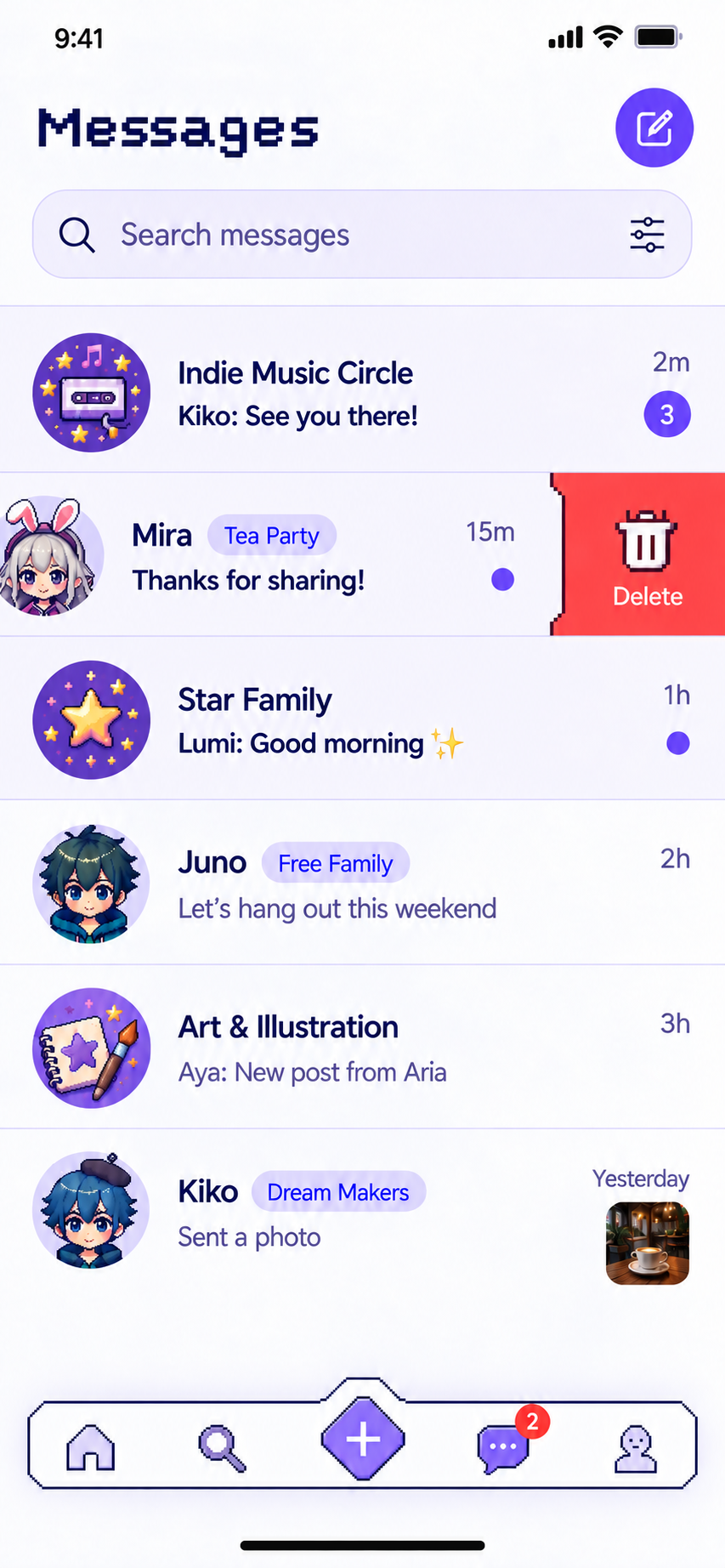
Swipe to Delete
05 — Testing & Handoff
We ran a 5-person usability test around the MVP core loop: register → complete profile → browse recommendations → enter a squad prototype → publish the first post. The goal was not statistical validation; it was to see whether users could move through the loop and where the flow broke.
For this discovery-stage test, I treated the numbers as usability funnel signals against BP expectations, then translated observed blockers into iteration priorities for beta planning.
What the Test Changed
P0 · Before Closed Beta
Make the post creation entry point more visible, because 2 of 5 users wanted to post but could not quickly find the plus button.
P1 · Before Open Beta
Increase avatar detail for creative students, including subculture accessories, stronger styling options, and richer personalization depth.
P2 · Phase 2
Add automatic reminders for squad co-creation tasks to prevent playlists or Zine activities from dropping off.
Outcomes
MVP Loop Partially Validated — users completed identity setup, engaged with recommendations, entered the squad prototype, and 3 of 5 published a first post.
Post Entry Became the Key Blocker — the 2 users who did not post were blocked by discoverability of the publish button, not by lack of interest.
Investor Demo Ready — the test translated directly into a focused beta backlog.
Reflection
The 5-user MVP test helped us identify the key break in the publishing flow at very low cost: the post creation entry point needed to be more visible before Closed Beta.
Next, the team will follow the 12-month roadmap and validate icebreaker cards and 1:1 interaction flows during Closed Beta (Months 6–8), using a second usability test and standardized funnel metrics to support pre-seed fundraising decisions.
Engineering Collaboration
Engineering feasibility shaped the design from the start. I worked with engineers to separate reusable platform conventions from COLOUR's custom brand moments, so the MVP could stay distinctive without overloading the first build.
Ran weekly design reviews with founders, frontend engineers, and backend engineers to align on scope, surface technical constraints early, and iterate fast.
Delivered Figma component documentation with spacing, states, and interaction specs to make engineering handoff clearer and reduce avoidable ambiguity.
Conducted 3 dedicated feasibility review sessions with frontend engineers before finalising the AI Identity Creation flow and Family Ecosystem screens.
Worked across a team of 2 frontend and 2 backend engineers, plus 1 part-time engineer overseeing code quality — bridging design intent and technical execution across web and mobile platforms.